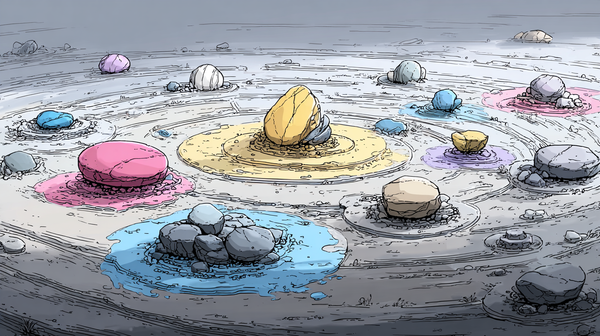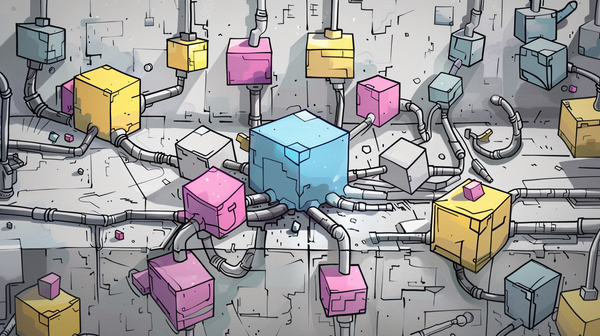
I wrote a post about thinking past medallion architectures. That one went a little deeper about the architectural characteristics that make thinking in “medallions” unnecessary.
You don’t need to internalize all that. I’m guessing you sense that data just doesn’t work, even with the fancy medallion architecture. What matters is how does this impact my business? How does this change what’s possible?
I frequently talk about that moment when someone asks you for data that’s even slightly out of phase with what you’ve planned and built. Your stomach drops. “Can we use that customer data from the BI pipeline for the new ML model?” It either gets filed into the infinite abyss (your backlog) or six months of work flashes before your eyes. Pipeline modifications. Coordination meetings. Schema changes cascading through three layers. Testing everything again.
That moment hits differently with Matterbeam.
One of our earliest customers had a COBOL system. Terabytes of it in a non-multi-tenant application. They’d been planning a two-year migration to something modern. The kind of project you put on the roadmap and hope the timeline doesn’t slip to three years. The one that requires endless ERD diagrams and white board sessions, documents and planning before you even get started.
They connected Matterbeam to their COBOL data to feed a database to run some reports. Then something else happened they just . . . started using the data. For other things. In their new systems. While COBOL was still running. They’re now effectively doing the migration in months instead of years. They didn’t need to create a perfect model and schema upfront to big-bang migrate. They’re not blocked waiting to move all the data first. The data just flows to wherever they need it. They can try different materializations quickly and iteratively and get value right away.
Their VP of Engineering told us they changed their company strategy based on what became possible. That’s not something you say about a pipeline or ETL tool.
With traditional architectures you build Bronze for raw data, Silver for clean data, Gold for business-ready analytics. Then someone needs data that doesn’t fit. Something non-analytical, or requiring a model that wasn’t in the original plan. Marketing wants household-level. ML needs raw anomalies included. Finance needs a different aggregation. You end up with Gold_marketing, Gold_analytics_v2, Gold_final_actually_final_for_the_board_deck.
With Matterbeam, you don’t think in layers. You have source facts. You can look at them raw. You have derived facts. You can add validations and transformations. You can add enrichment and get derived data with geographic data. Each consumer just reads from whichever point makes sense for them. Each derived dataset can be drilled into to see how it was created.
Want to experiment with a new approach? Fork the transformation graph. Test it. If it works, keep it. If it doesn’t, delete it. The original keeps running. No coordination needed. Let me say it again, you can use the same data without messing with the other uses.
This is where it gets interesting. Customers start with one use case. Usually something pretty straightforward, like syncing Salesforce data or feeding reports. Standard stuff.
Then some weeks later, they get the request, and instead of the stomach drop moment, they have a realization. “Wait, that data is just sitting there. What if we . . . ”
Suddenly they’re building product features they’d shelved as impractical. They’re testing ML models they didn’t have time to try. They’re feeding RAG pipelines and fine-tuning experiments that were “someday” projects — their data scientists just pull what they need and iterate instead of waiting on engineering sprints. They’re materializing the same data into Elasticsearch for search, Redis for APIs, and Snowflake for analytics, all simultaneously, all reading from the same facts.
One customer cut their data warehouse costs because they stopped dumping everything into it. Now they only materialize what actually needs to be there. They’re using the analytics database to only do the analytics they care about: weirdly shocking. Everything else lives in Matterbeam until someone needs it somewhere specific. When a new analytic requirement pops up, they create it then. In minutes.
Most real-time systems are parallel systems or bolt-on processes. What nobody tells you about these systems: they’re usually real-time until something breaks, and then they’re real-time broken.
Matterbeam decouples sources from destinations. With Matterbeam, if a destination falls behind or fails, it just . . . catches up when it’s ready. Everything’s in an immutable log. Nothing upstream cares. One system being slow doesn’t cascade into everything else being broken.
We had a customer whose reporting went from “refresh overnight” to “two-minute fresh data.” Not because they optimized their queries, but because the data just flows continuously. When they need it somewhere, it’s already there or it gets there in minutes.
Another key insight of Matterbeam, everything is a real-time stream whenever possible. Streaming is more fundamental than batches. You can feed all your batch systems from a stream, but when you need the stream, you can just tap it directly. Real time, now, not in some future-maybe-wouldn’t-it-be-nice scenario.
This might be the most important part. When trying a new approach costs six months of engineering time, you don’t try things. When experimenting costs weeks, you don’t. You pick one path, commit to it, and pray it works.
When trying a new approach costs ten minutes, you try everything. Different data models. Different systems. Different transformations. Your data scientists test five feature engineering approaches in an afternoon instead of filing five tickets for next quarter. Your AI experiments run on production-quality historical data, not stale CSV exports. You learn what actually works instead of defending what you already built. And when you need to redo it again, you can replay it from the beginning and fix it.
One customer had projects they weren’t even going to attempt because they seemed impossible with their existing infrastructure. They’re doing them now. Not because Matterbeam is magic, but because the infrastructure stopped being the bottleneck.
You know what’s really different? The conversations change. Nobody’s debating whether a transformation belongs in Silver or Gold because there are no layers. Nobody’s scheduling a six-person meeting to discuss schema changes because consumers just transform data how they need it. Nobody’s afraid to connect a new system because you can always rewind and replay if something goes wrong.
It’s not that data engineering goes away. It’s that data engineering becomes about building useful things instead of managing pipeline dependencies and coordination overhead.
In the longer post, I talked about how medallion architecture conflates quality with purpose, forces premature decisions, and optimizes for pipeline construction instead of data consumption. That’s all true and important.
But here’s what it feels like day to day: You stop thinking about where data lives and start thinking about what you want to do with it. Data flows. You materialize it where you need it, when you need it, how you need it.
And then you realize you’ve been accepting “data is just hard” for so long that you forgot it doesn’t have to be.
Stop waiting on data infrastructure. With Matterbeam, your AI experiments run faster — or we refund 100%. Talk to us. If your team isn’t iterating faster in 60 days, you get your money back.